
Marble Fireplaces: Timeless Design, Natural Stone & Lasting Beauty
A marble fireplace has a way of changing the character of a room. It is not only there to frame the fire or provide a finished surround. When the right stone is selected and carefully detailed, the fireplace can become one of the strongest architectural elements in the entire space.
Marble has been used in architecture for centuries for a simple reason: no manufactured surface can quite reproduce the depth and variation found in natural stone. Every block has its own veining, movement, tone, and small variations. Once that block is cut and shaped into a fireplace, those characteristics become part of the design.
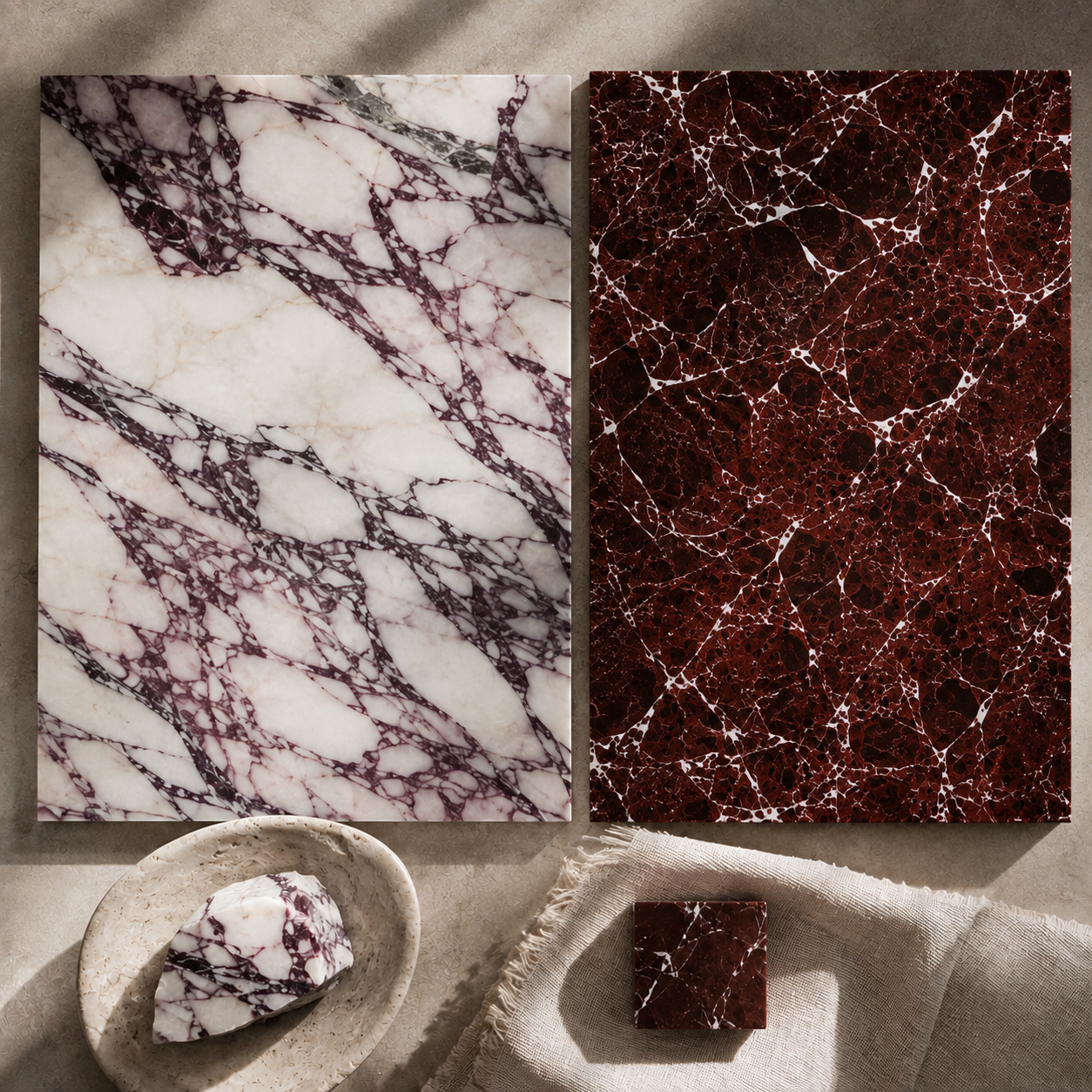
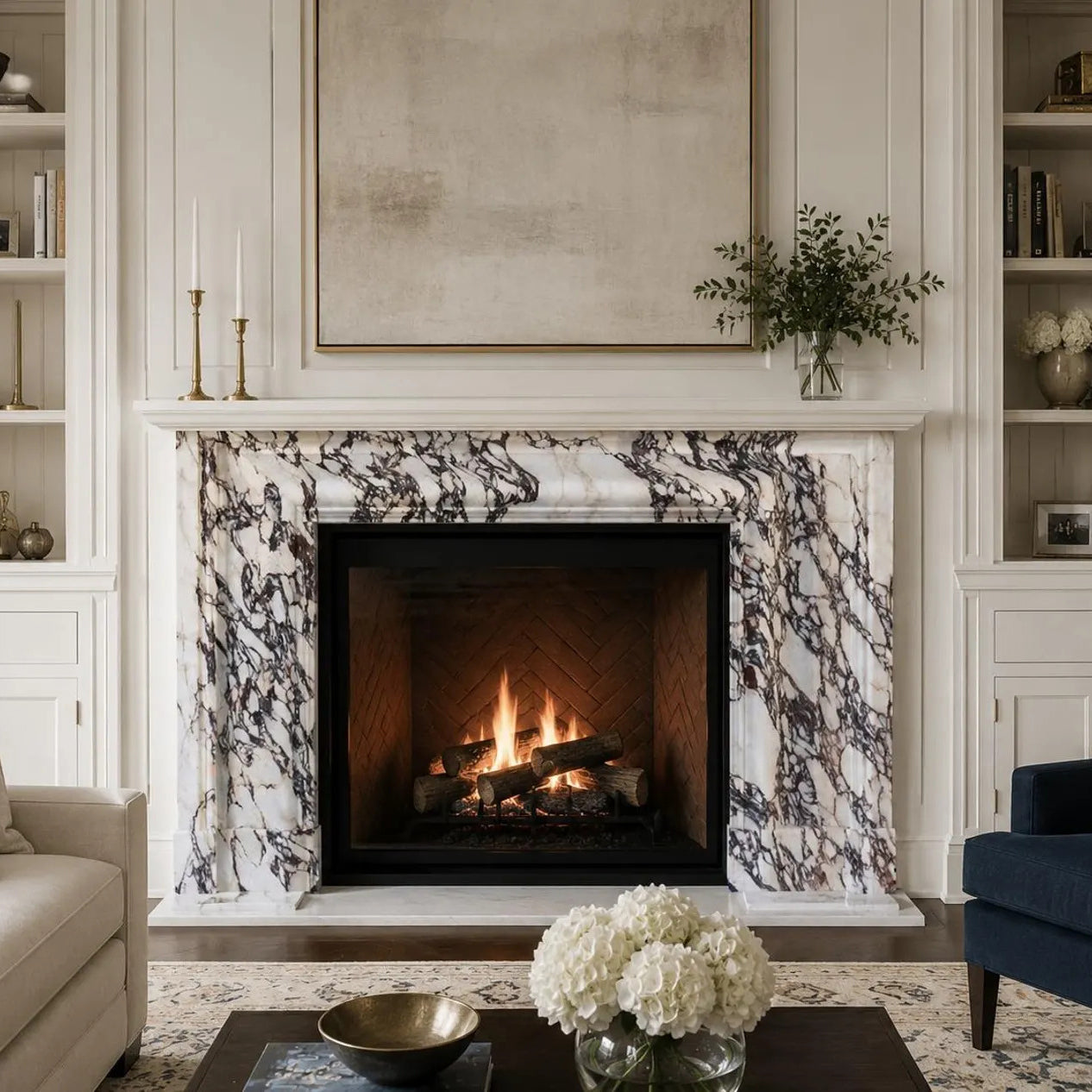
White marble can create a calm and refined interior. Calacatta Viola introduces stronger movement and distinctive color. Rosso Levanto brings depth and contrast, while warm travertine can give a room a softer, more natural atmosphere.
For a homeowner, architect, or interior designer looking for something that will remain relevant long after current trends have changed, natural marble is a material worth considering.
Why Choose a Natural Marble Fireplace?
The attraction of marble goes beyond its appearance.
Natural stone has a depth that is difficult to reproduce with engineered or printed surfaces. Its veins are not simply a pattern applied to the surface. They continue through the stone, changing in direction, intensity, and scale depending on how the block is cut.
This becomes particularly important when marble is used for a fireplace.
A fireplace surround occupies a relatively large visual area, so the character of the individual slab or block becomes much more noticeable. A vein that looks subtle in a small sample can become a major feature once it extends across a large surround.
This is one of the reasons marble selection should take place before the final production details are decided.
The stone is not simply a finish applied to a completed design. In many projects, the stone itself influences the design.
Every Marble Fireplace Is Naturally Different
No two blocks of natural marble are exactly the same.
Even when two blocks come from the same quarry and are sold under the same marble name, their veining and overall movement can be quite different. One may have relatively quiet veins, while another may contain stronger movement, contrasting tones, or a much more dramatic pattern.
For a fireplace, this difference matters.
A large surround gives the natural veins enough space to become part of the architecture. Depending on the block, the veins may run horizontally, vertically, diagonally, or in a combination of directions.
At Muka Marble, we consider these characteristics when selecting stone for a project. Color is important, but so are the structure of the block, the direction and intensity of the veining, and the way the material will work with the dimensions of the fireplace.
The objective is not simply to find a beautiful marble.
It is to find a marble that works with the design.
Marble Can Define the Atmosphere of a Room
The fireplace is naturally one of the first elements people notice when they enter a room. The choice of marble can therefore have a significant effect on the atmosphere of the entire interior.
A light marble with restrained veining can make a fireplace feel elegant and understated. A strongly veined Calacatta can create a more expressive focal point. Rosso Levanto introduces a darker, richer character, particularly when paired with lighter walls, wood, or neutral furnishings.
Travertine offers another direction. Its warmer tones and more organic appearance can make a room feel relaxed and architectural at the same time.
This is why there is no single “best” marble for a fireplace.
The right choice depends on the architecture, natural light, surrounding materials, furniture, and the atmosphere the designer wants to create.
Classic and Contemporary Fireplace Designs
Marble is often associated with traditional fireplaces, but its versatility extends well beyond classical interiors.
A fireplace with carved details, layered profiles, and traditional proportions can work beautifully in a classic residence. On the other hand, a simple slab fireplace with clean edges and minimal detailing can feel completely at home in a contemporary interior.
In modern projects, the stone itself can provide almost all of the visual interest.
A strongly veined marble does not necessarily need elaborate molding or decorative carving. The natural movement of the stone can be enough.
For more traditional designs, the same material can be shaped with profiles, stepped edges, or other architectural details.
The important part is finding the right balance between the stone and the architecture around it.
Choosing the Right Marble for a Fireplace
Selecting the marble is one of the most important decisions in the entire project.
The first consideration is usually color, but there are several other factors that can have an equally important effect on the finished fireplace.
The direction of the veins is one of them.
A marble with strong linear movement may look completely different depending on whether it is installed vertically or horizontally. The position of the veins can also affect how the eye follows the shape of the fireplace.
The scale of the pattern matters as well. A marble that looks beautiful on a small sample may not produce the same visual effect across a large surround.
For this reason, we prefer to consider the actual block and the intended dimensions together whenever possible.
A good marble selection is not only about choosing the most attractive stone. It is about understanding how that stone will behave once it becomes part of the finished design.
Bookmatching and Vein Direction
Strongly veined marble offers opportunities that are not possible with uniform materials.
Bookmatching is one of the best-known examples. Two slabs are cut and positioned so that the natural veining mirrors across the center line, creating a symmetrical composition.
When the marble has distinctive movement, the result can be striking.
Calacatta varieties are particularly well suited to this approach because their veins can create strong visual movement across a large surface.
However, bookmatching is not simply a matter of placing two pieces next to each other. The selection of the original block, the cutting direction, the position of the center line, and the continuity of the veins all affect the final result.
When done well, the natural pattern becomes part of the architecture rather than something that simply happens to be present on the surface.
Handmade Marble Fireplaces
A handmade marble fireplace allows the design to be developed around the actual space rather than around a predetermined factory size.
This can be especially important in custom residential and architectural projects where proportions need to work precisely with the surrounding walls, ceiling height, flooring, furniture, and fireplace opening.
Details such as edge profiles, corner joints, surface finish, panel proportions, and overall thickness can all change the appearance of the finished piece.
Working with natural stone also requires attention to the material itself.
A particular block may have a vein exactly where a joint was originally planned, or a section of the stone may have a stronger movement than expected. Good fabrication is not only about following a drawing. It is also about understanding the material and making decisions that preserve its natural character.
That is one of the differences between working with natural marble and working with a standardized manufactured surface.
Is Marble Suitable for a Fireplace?
Marble has been used around fireplaces for generations, but the suitability of a particular installation depends on the complete fireplace system.
The type of fireplace, heat output, construction method, surrounding materials, required clearances, structural support, and local building requirements all need to be considered.
The marble itself is only one component of the installation.
For this reason, the fireplace surround should be designed and installed in accordance with the requirements of the specific fireplace system. Before production begins, the relevant measurements, clearances, support requirements, and installation details should be confirmed with the fireplace manufacturer or qualified installer.
This is particularly important for custom projects, where the stone dimensions are being developed around an existing or planned firebox.
Caring for a Natural Marble Fireplace
Marble can remain beautiful for many years when it is properly maintained.
As with other natural marble surfaces, routine cleaning should be carried out with products suitable for natural stone. Harsh or inappropriate chemicals can affect certain finishes or surfaces, so the care requirements of the particular marble should always be taken into account.
It is also worth remembering that natural marble is not intended to look perfectly uniform.
Small differences in tone, veining, and surface character are part of what makes natural stone distinctive. They are not manufacturing imperfections.
In fact, these variations are often what give an older marble fireplace its character.
With appropriate care, the stone can continue to develop its own visual presence over time rather than becoming dated as interior trends change.
Why Marble Remains a Timeless Material
Interior design trends change constantly.
Certain colors become popular, particular finishes come into fashion, and materials that were once considered contemporary can eventually look dated.
Natural marble has a different relationship with design.
It has been used in architecture for centuries, from historic buildings to contemporary residences, and it continues to work because its appeal does not depend entirely on a particular trend.
The key is not necessarily choosing the most fashionable marble today.
A well-proportioned fireplace made from carefully selected natural stone can still feel appropriate many years from now because the material itself provides depth and character.
That is what makes marble different from a surface designed to imitate a particular visual trend.
A Fireplace Designed Around Your Space
A custom marble fireplace should be considered as part of the room rather than as an isolated product.
The dimensions of the surround need to relate to the wall. The proportions should make sense with the ceiling height. The finish should work with the flooring and other architectural materials. Even the direction of the marble veins can influence how the fireplace sits within the room.
These details become particularly important with large surrounds.
A fireplace can be beautifully manufactured and still feel out of place if its proportions are not right for the space. Conversely, a relatively simple design can become extremely effective when the dimensions, material, and detailing are properly balanced.
At Muka Marble, we approach each project by considering the stone and the space together.
The marble selection, dimensions, design details, vein direction, edge treatment, and finish can all be considered as part of the same process.
The purpose is not to make the fireplace unnecessarily complicated.
It is to make sure that every part of it belongs to the space.
More Than a Fireplace
A natural marble fireplace can become one of the elements that people remember most about a room.
It brings together several things that are difficult to separate once the project is complete: natural material, craftsmanship, architectural proportion, and interior design.
The character begins with the block of stone.
The veins already exist. The color is already there. The movement of the material has been formed naturally over an extremely long period of time.
Our role is to understand that material, select the right block, and shape it in a way that allows those characteristics to work with the architecture.
That is ultimately what makes a natural marble fireplace different.
It is not simply a surround placed around a fire.
It is a piece of natural stone, shaped specifically for a space, with a character that cannot be reproduced exactly in another piece.